
Pharmaceutical Printing Essential Provider – Tulja Enterprise
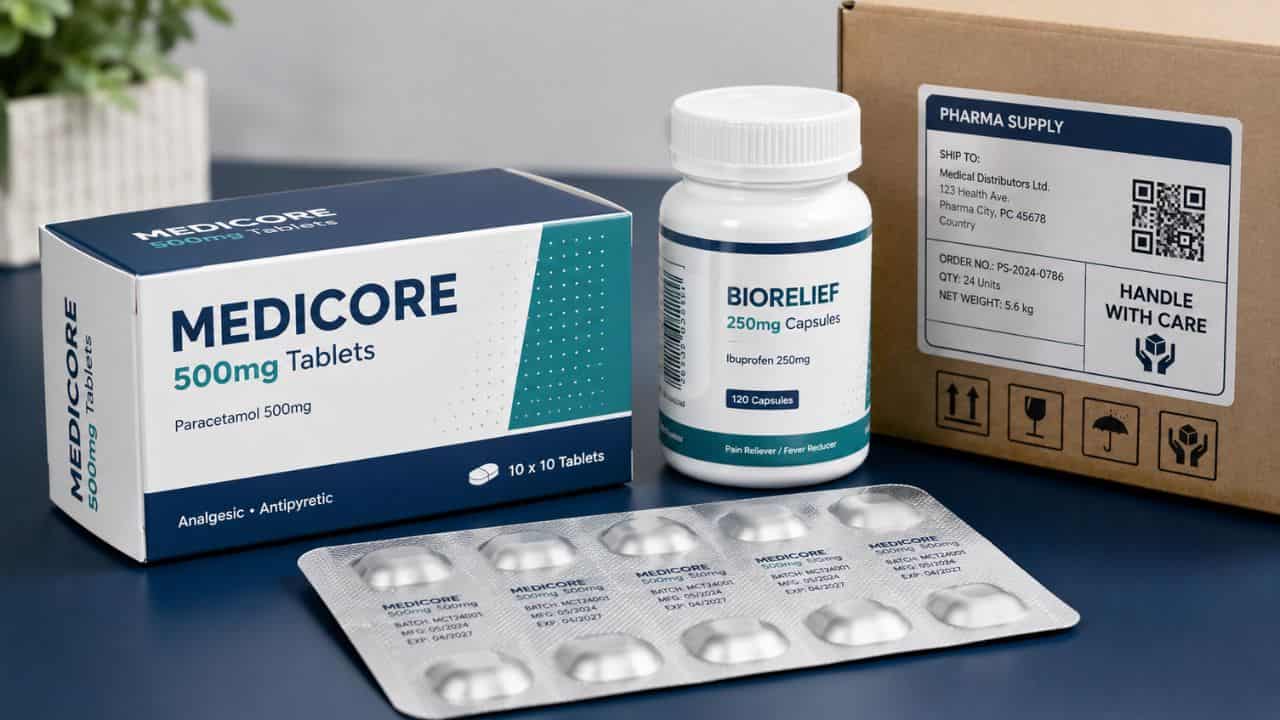
Pharmaceutical manufacturing companies deal with more printing requirements than most other industries. Packaging, marketing collateral, and HR paperwork all carry strict quality and consistency expectations.
Working with a single experienced pharmaceutical printing essential provider, instead of five or six separate vendors, removes a major source of delay and error. One partner learns your artwork standards, batch coding formats, and approval workflows once, then applies that knowledge across every print job you send.
This page walks through the complete printing requirements of a pharmaceutical manufacturing operation, explains when offset printing makes sense versus digital printing, and outlines what procurement and packaging teams should evaluate before signing with a supplier.
Tulja Enterprise, a Vadodara-based printing partner serving pharmaceutical and industrial clients, is used as a practical reference point throughout.
Printing Requirements Across a Pharmaceutical Manufacturing Business
Most procurement teams associate pharmaceutical printing with packaging alone. In practice, a manufacturing plant generates printing needs across six distinct areas: primary packaging, secondary packaging, shipping and logistics, marketing and field force material, and corporate or HR printing. Each area has its own volume pattern, accuracy requirement, and preferred print method.
Primary Packaging Printing
Primary packaging touches the product directly, so print accuracy here affects patient safety, not just brand appearance. Offset printing handles the bulk of high-volume foil and label runs, while digital printing takes over wherever batch-specific or expiry-specific data needs to change from run to run.
| Printing Item | Typical Print Method | Purpose |
|---|---|---|
| Blister Foil | Offset | Protects tablets and capsules; carries batch and expiry details |
| Strip Packing Foil | Offset | Seals strips; carries product and batch information |
| Bottle Labels | Offset or Digital | Product identification and dosage instructions |
| Vial Labels | Digital | Small-format labels with frequently updated batch data |
| Ampoule Labels | Digital | Variable data for injectable product batches |
| Sachet Printing | Offset | High-volume powder or liquid dose packaging |
| Pouch Printing | Offset | Larger-volume dose or sample packaging |
Secondary Packaging
Secondary packaging protects the primary pack and carries most of the regulatory and brand information a pharmacist or distributor sees first. Offset printing remains the standard for high-volume, stable-design cartons. Digital printing steps in for serialized cartons, short sample batches, or SKUs that change frequently.
| Printing Item | Typical Print Method | Purpose |
|---|---|---|
| Folding Cartons | Offset | Standard retail-ready packaging |
| Mono Cartons | Offset | Single-unit product cartons |
| Tablet Strip Cartons | Offset | Houses multiple strips per carton |
| Serialized Cartons | Offset base plus Digital overprint | Unique QR code or barcode per unit for traceability |
| Sample Pack Cartons | Digital | Low-volume, frequently revised doctor samples |
Shipping & Logistics Printing
Shipping and logistics printing rarely gets the same attention as packaging, but barcode readability and label durability directly affect whether a shipment clears a distributor’s warehouse without delay. Corrugated shipping boxes generally use offset, litho-laminated printing for brand consistency at scale. Shipping labels, pallet labels, cold chain labels, and dispatch stickers are almost always digital, since each carton or pallet carries unique tracking data. Cold chain labels also need to survive refrigerated or frozen conditions without the print smudging or the label lifting.
- Corrugated Shipping Boxes — Offset, litho-laminated
- Shipping Labels — Digital
- Pallet Labels — Digital
- Cold Chain Labels — Digital
- Dispatch Stickers — Digital
Corporate & HR Printing
HR and administration teams generate a steady, recurring stream of print requirements that has nothing to do with packaging but still benefits from the same vendor relationship. New joining kits, ID cards, and certificates need consistent branding, and onboarding volumes fluctuate with hiring cycles, which is exactly the kind of unpredictable, short-run work digital printing handles well. Letterheads, envelopes, and general stationery are ordered in bulk and printed offset.
| Printing Item | Typical Print Method | Purpose |
|---|---|---|
| Business Cards | Digital | Individual employee or department cards |
| Employee ID Cards | Digital | Variable data per employee |
| Letterheads | Offset | Bulk corporate stationery |
| Envelopes | Offset | Bulk corporate stationery |
| Joining Kits | Digital | Short, variable runs per new hire |
| Employee Certificates | Digital | Training and recognition, individual names |
| Training Manuals | Offset or Digital | Depends on print run size |
| Notice Boards | Digital | One-off, low-volume printing |
| Office Branding | Offset or Digital | Depends on material and volume |
| Corporate Stationery | Offset | Bulk, stable-design printing |
How One Printing Vendor Simplifies Pharmaceutical Procurement
- Centralized purchasing: one purchase order process and one billing cycle instead of coordinating five vendor relationships for six categories of print.
- Better communication: a vendor who already understands your artwork, packaging structure, and approval chain needs less explanation for every new job.
- Faster approvals: familiar formats move through internal QA and regulatory sign-off faster because reviewers already know what to check for.
- Artwork familiarity: dies, plates, and design files stay on file, so a reorder does not start from zero.
- Easier repeat orders: standard SKUs can be reordered with a short confirmation rather than a full briefing.
- Quality consistency: the same paper stock, ink calibration, and finishing standard apply across every job.
- Reduced operational risk: fewer vendors means fewer points where a miscommunication can turn into a labeling error or a missed deadline.
What Pharmaceutical Companies Should Look for in a Printing Supplier
Procurement teams evaluating a pharmaceutical printing supplier should look past price per unit and check for the following:
- Print quality and color consistency across repeat runs
- Material consistency in paper stock, foil grade, and ink from batch to batch
- Turnaround time, including emergency or rush order capability
- Variable data printing capability for batch coding and serialization
- Demonstrated packaging expertise, not just general commercial printing
- Understanding of pharmaceutical regulatory and labeling requirements
- Corporate billing and purchase order support for enterprise procurement
- Scalability to handle both small sample runs and large production orders
- Support for recurring and repeat orders without re-briefing each time
- Clear, responsive communication, especially during artwork revisions
- Confidentiality around unreleased product names, formulas, and packaging designs
- A documented quality assurance process at the vendor’s own facility
Common Printing Challenges in Pharmaceutical Manufacturing
Packaging and labeling errors are consistently cited as one of the leading causes of pharmaceutical product complaints and recalls industry-wide, which is why print quality control gets treated as a compliance issue rather than a design preference. The problems procurement and packaging teams report tend to repeat across companies:
- Last-minute artwork revisions that arrive after a print run has already started
- Label mismatches between primary and secondary packaging
- Packaging delays that push back a product launch or a shipment
- Incorrect or misaligned batch and expiry information
- Vendor communication gaps during time-sensitive approval cycles
- Coordinating multiple suppliers for what should be one packaging job
- Material shortages on foil, paper stock, or label stock during peak demand
- Emergency print requirements with almost no lead time
Most of these problems trace back to the same root cause: too many vendors, too little institutional knowledge of the product line, and too little slack built into the artwork approval process.
Why Tulja Enterprise is a Trusted Pharmaceutical Printing Partner
Tulja Enterprise, based in Vadodara, Gujarat, works with pharmaceutical manufacturers and other industrial clients across both packaging-related and corporate printing requirements. As a pharmaceutical printing vendor, Tulja Enterprise supports:
- Corporate stationery and office branding
- Employee printing, including ID cards, joining kits, and certificates
- Pharmaceutical marketing materials such as brochures and MR literature
- Packaging support across cartons, labels, and inserts
- Business cards and general corporate collateral
- Bulk recurring printing for repeat SKUs and standard stationery
Being based in Vadodara, a city with a long-established pharmaceutical and chemical manufacturing base, keeps Tulja Enterprise close to the manufacturers it serves, which shortens turnaround for both routine reorders and urgent requirements. For a pharmaceutical manufacturer trying to reduce the number of vendors it manages while keeping print quality consistent across packaging, and corporate needs, Tulja Enterprise functions as a dependable pharmaceutical printing partner and pharmaceutical printing supplier across most of these categories.


